The best headphones for Ableton Live depend on where you work and what you are doing. For mixing in a quiet room, I would start with an open-back model: the Sennheiser HD 490 PRO is my main recommendation, while the HD 560S is the better-value route. For recording, a shared room or travel, choose closed-back headphones: the Sennheiser HD 480 PRO and beyerdynamic DT 700 PRO X are the strongest options here. Sony's MDR-7506 covers a tighter budget, and the Audio-Technica ATH-M50x is the portable all-rounder.
Use a wired connection when you play instruments, record or make timing-sensitive edits. Ableton's latency guidance warns that Bluetooth and wireless casting add substantially more delay than cabled audio.
| Need | Starting recommendation | Why |
|---|---|---|
| Mixing in a quiet room | Sennheiser HD 490 PRO | Open studio design, two pad tunings and low weight for the class |
| Lower-cost critical listening | Sennheiser HD 560S | Broadly neutral independent measurements at a lower tier |
| Recording or a shared room | Sennheiser HD 480 PRO | Closed current studio design with a recording-focused package |
| Durable closed-back option | beyerdynamic DT 700 PRO X | Detachable cables, replaceable parts and 48-ohm nominal impedance |
| Budget tracking and editing | Sony MDR-7506 | Folding closed design and long-standing studio utility |
| Portable all-round use | Audio-Technica ATH-M50x | Folding cups and three detachable cables |
Choose open-back or closed-back before choosing a brand
Open-back headphones let air and sound pass through the earcups. They do not isolate you from the room, and people nearby can hear what you are playing. That makes them a poor match for tracking vocals beside a live microphone. In a quiet room, the same open construction can make long editing and mixing sessions feel less enclosed.
Closed-back headphones contain more sound and reduce some outside noise. They are the practical choice when a microphone is in the room, when other people are nearby or when you cannot control the background noise. The trade-off is that the closed cup can introduce its own resonances. “Open” does not automatically mean accurate, and “closed” does not automatically mean bass-heavy.
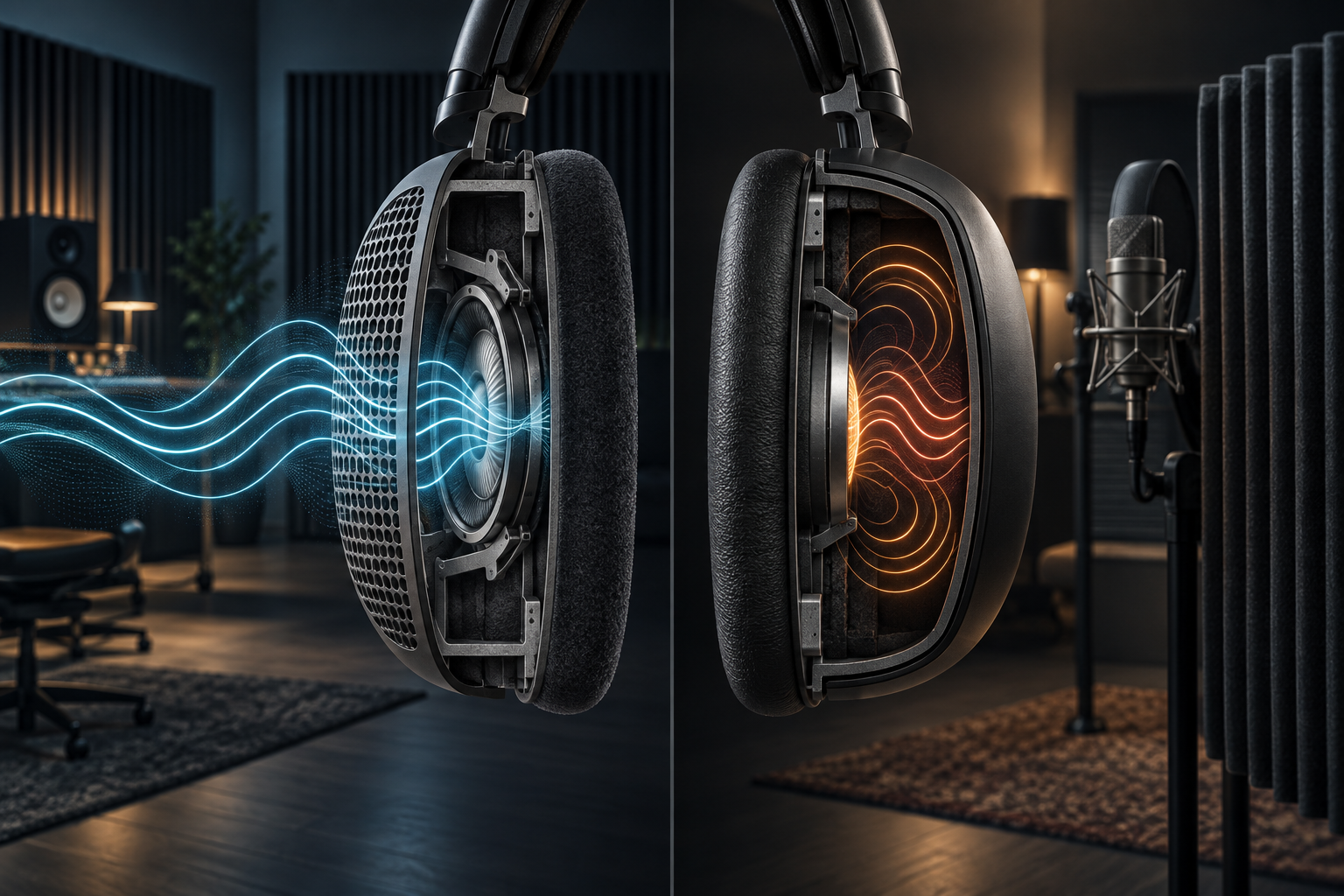
The six best headphones for Ableton Live
1. Sennheiser HD 490 PRO — best overall for mixing in a quiet room
The HD 490 PRO is the pair I would put first for a producer who works in a quiet room and wants one serious open-back reference. The official specification lists a 130-ohm open design, a 260 g weight without cable and two pad sets. The producing pads and mixing pads are not cosmetic extras: they give you two repeatable listening perspectives without changing headphones.
The limitation is straightforward. There is no useful isolation, so this is not the pair for microphone tracking or a noisy room. The 130-ohm rating also means I would check the headphone output of a small interface or laptop before buying. Impedance alone cannot tell you whether the result will be loud enough.
2. Sennheiser HD 560S — best value for critical listening
The HD 560S is the sensible step down when the HD 490 PRO is beyond the budget. Sennheiser lists an open 120-ohm design with a 1.8 m cable and 280 g weight. Independent testing on a GRAS rig found a broadly neutral response with a small rise around 4 kHz, while also showing that ear position can change the balance. That is a useful reminder that fit matters even with a well-regarded reference headphone.
Like every open-back option here, it leaks and provides little isolation. I would choose it for arrangement, editing and balance decisions in a quiet room, then keep a closed pair nearby if the same workspace is used for recording.
3. Sennheiser HD 480 PRO — best premium closed-back option
The HD 480 PRO is the closed-back counterpart for readers who need isolation without moving to a general consumer headphone. Sennheiser launched it on April 21, 2026; the production specification lists 130 ohms and 272 g without cable. The base package includes recording pads, a 3 m coiled cable and a bag.
It is a new and premium model, so there is less independent long-term evidence than for the MDR-7506 or ATH-M50x. I would choose it when vocal tracking, a shared room or late-night isolation is part of the same Ableton setup. I would still cross-check final low-end balance on another playback system.
4. beyerdynamic DT 700 PRO X — best durable closed-back midrange pick
The DT 700 PRO X is the practical middle ground: closed, serviceable and built around detachable cables. The official product page lists 48 ohms, 350 g without cable, and both 1.8 m and 3 m cables. That lower nominal impedance does not guarantee compatibility with every source, but it is a less demanding starting point than the 120- and 130-ohm Sennheisers.
Independent comparisons show why I would use it mainly for recording and monitoring rather than declare it universally neutral. Sound On Sound's comparative KU100 measurements found more response variation and slower decay around 100–500 Hz than the open DT 900 PRO X. The reviewer also states that the rig is better for comparison than absolute claims. At 350 g, this is the heaviest recommendation on the list.
5. Sony MDR-7506 — best budget pair for tracking and editing
The MDR-7506 earns its place because it solves a basic studio problem without pretending to be a luxury object. Sony's closed folding design uses 40 mm drivers and includes a pouch plus a 3.5/6.3 mm adapter. It packs easily, isolates better than an open pair and is useful for recording, comping and cleanup.
Its fixed cable is the main mechanical weakness. The tonal balance also needs context: SoundGuys measured reduced energy around 150–400 Hz and elevation around 2.5–5 kHz relative to its target. That can make upper mids and sibilance stand out. I would use this character to find problems, but I would not make final bass decisions on it alone.
6. Audio-Technica ATH-M50x — best portable all-rounder
The ATH-M50x makes sense when one pair has to fold into a bag, connect to several devices and cover writing, editing and occasional tracking. The technical file lists a 38-ohm closed design, 285 g weight and three detachable cables. That package is more flexible than the Sony's fixed cable.
I would not rank it above the open Sennheisers for critical tonal work. Independent testing describes a studio/consumer tuning rather than a strictly neutral reference and reports fit-dependent bass consistency. Buy it for portability and versatility, then learn its balance by comparing familiar releases and a second playback system.
How to connect headphones to Ableton Live
If you use an audio interface, connect the headphones to its dedicated headphone output. In Live, open the audio settings, select the interface and confirm that the output channels feeding the headphone mix are active. Ableton's audio-interface setup guide covers the driver and device selection.
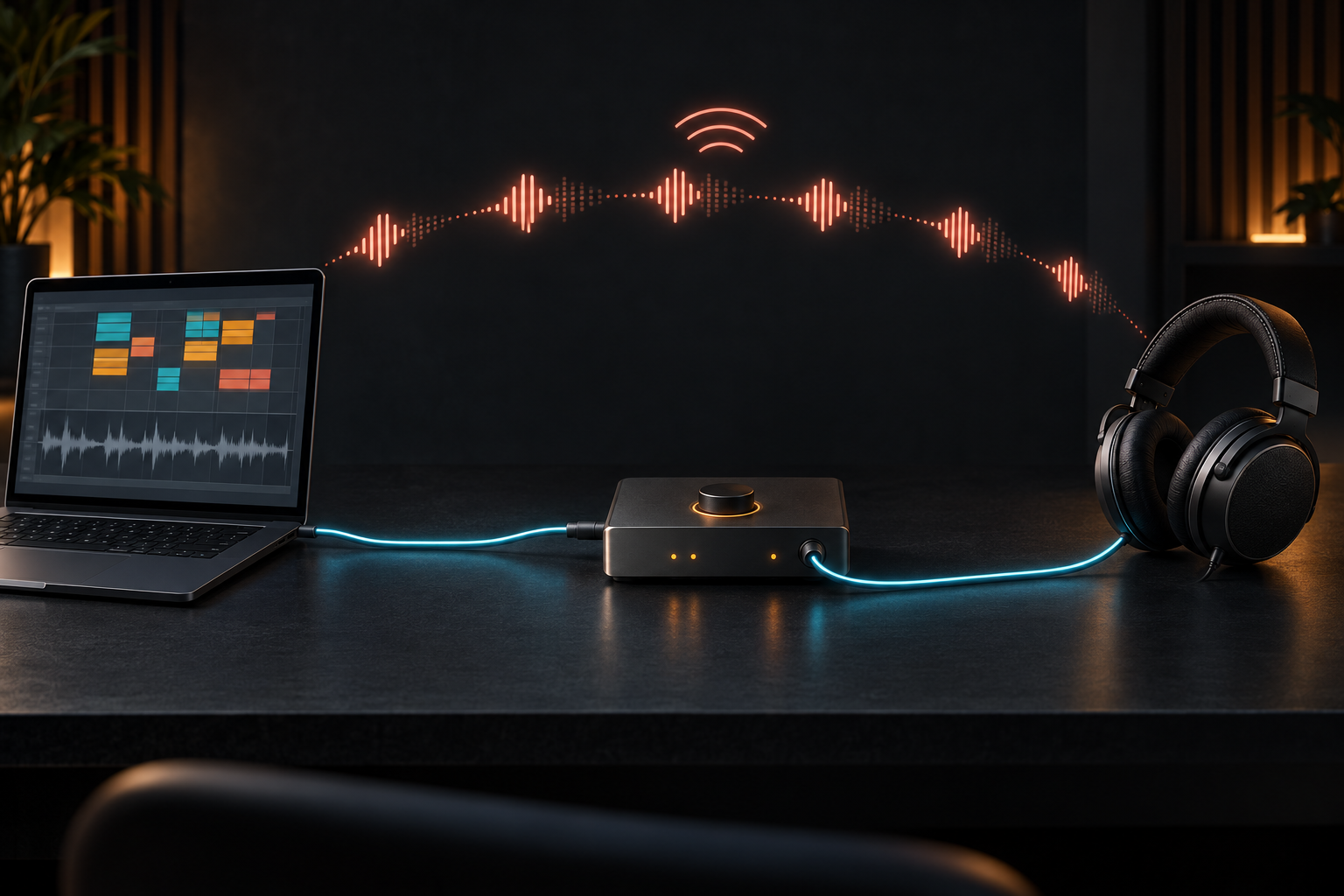
Bluetooth is fine for casual listening and checking how a mix behaves on a consumer device. It is the wrong default while playing MIDI instruments, recording or editing transients because the wireless stage adds delay. If Live plays through the laptop speakers instead of the headphones, check the selected output device and output routing before changing buffer settings. Our Ableton recording latency guide explains the rest of that signal path.
Impedance is not a quality score
A 130-ohm headphone is not inherently better than a 38-ohm headphone. It is also not automatically quieter in every setup. Shure's specification guide explains that sensitivity and the source output matter alongside impedance. Two headphones with the same impedance can need different amounts of power to reach the same level.
Before buying a high-impedance pair for a compact interface, check the interface's headphone-output specification and the headphone's sensitivity. If the documentation is vague, buy from a seller with a clear return policy and verify the combination during the return window. Do not chase the widest printed frequency range either: a claim such as 5 Hz–40 kHz says nothing by itself about balance through the audible range.
Can headphones replace studio monitors?
For a bedroom, apartment or late-night workflow, headphones can be the primary monitoring tool. They remove the room from the equation, allow detailed editing at low volume and make consistent work possible when speakers are impractical.
One pair still gives you one acoustic perspective. Before release, check the mix on another known system: speakers, a second headphone, a car or a small consumer device. The goal is not to make every playback system sound identical. You are looking for decisions that collapse outside the headphone you know best, especially vocal level, kick-and-bass balance and harsh upper mids.
My final decision path
- Quiet room and critical balance decisions: start with HD 490 PRO; choose HD 560S when value matters more than the premium package.
- Microphone in the room or a noisy/shared space: choose HD 480 PRO or DT 700 PRO X.
- Tight budget: use MDR-7506 for tracking and editing, with a second check for low-end and upper-mid balance.
- One pair that travels: ATH-M50x is the easiest all-round package, though it is not my first neutral mixing choice.
- Unsure whether your interface will drive a model: verify output power, impedance and sensitivity together.
Whichever pair you choose, set up Live and the interface before judging it. The Ableton Live 12 setup checklist gives you a controlled order for the audio device, buffer, plug-in scan and library settings.